

Mist Elimination and Gas Liquid Separation
Eventus provide gas/liquid separation and mist elimination solutions and services to multiple industries in Turkey and surrounding countries via its top tier Partner Munters. Munters mist elimination systems are virtually everywhere there are liquids and gases that need to be separated. The industries we provide Mist elimination solutions are:
Marine & Shipyard

Munters provides designs and engineering solutions for the following Marine industries:
Munters marine mist eliminators allow the engines to breathe unrestricted while at the same time effectively removing
the salt content of the air. Every type of pleasure boat and boating environment is catered for, from the calmest inshore
waters with low saline content right up to extreme conditions. Yet the mist eliminator units are unobtrusive, blending in
smoothly with the outer surfaces of both modern and classical boat designs. Munters’ units are suitable both for
newbuilds and also for retrofitting. You scarcely notice them as they look like an integral functioning part of the overall
vessel design – and that’s exactly what they are!
Breathe easy!
The secret of the technology lies in preventing water and especially salt water from entering, while still ensuring efficient
aspiration for the engines and the air conditioning at all times. And when the engines
breathe easily, they perform effortlessly, optimizing fuel consumption, performance and extending service life.
Air in, water out – how do we do it?
The principle of the mist eliminator is ingeniously simple and simply ingenious. Air entering the mist eliminator has to
pass through precision-engineered profiles. As the moisture-laden air impinges on the profiles, the droplets coalesce
and form a liquid film that is heavier than the air. This liquid drops down the profiles into drainage channels. The exact
size, shape and angle of the eliminator ensure that the liquid is separated without causing unacceptable pressure loss.
The technology of mist elimination pioneered by Munters has been extensively used throughout the industry for nearly
half a century and its application in boatbuilding has been widely adopted by designers and builders for decades.
Ready to fit marine mist eliminators
Munters’ range of marine mist eliminators addresses the whole range of pleasure boat applications, from freshwater
and inshore usage right up to extreme green water conditions with high salt, sand and contaminant content.
Munters’ mist eliminators are available in seawater-resistant aluminium and talcum-reinforced polypropylene (for
strength) and can be delivered in marine white, black or natural. Other materials and colours are available on request.
They come in single- or 2-stage configurations, including an additional filter with low installation depths.
Keeping the heart of your pleasure boats healthy
Prevent water spray and corrosive substances from entering
the engine room
- Protect the interior of yourboat, for less work and more pleasure
- Prolong the life, performance and appearance of your high value engines
- Reduce downtime required for Maintenance
- Ensure optimal performance with full spray protection
- Minimal pressure loss – let your engines really breathe
- Unobtrusive design – suits modern and classic boat design
- Custom-build options
- Proven technology
- Available in weight-saving polypropylene and aluminium as well as in special materials and colours
Marine Mist Eliminator Products
DF2800 Mist Eliminator
DF 2800 is a ready-to-install droplet separator for use in
many application areas. It is available fit a wide range of
operating conditions. DF 2800 droplet separator provides
high efficiency droplet separation and extreme low pressure
drop even at medium face velocities giving energy saving
operation. The droplet separator can be configured to most
individual performance and installation situations, providing
a cost effective solution. DF 2800 droplet separator is an
excellent choice for keeping rain, mist and larger fog water
droplets out of building or marine ventilation systems. This
helps to reduce corrosion, to increase filter lifetime and to
reduce moisture throughout the system.
DF 2800 droplet separator is designed for use in many
applications and for an easy integration into the
superstructure. The unit is suitable for use at face velocities
between 1 and 4 m/s.

DF4200 Mist Eliminator
DF 4200 droplet separator provides high efficiency droplet
separation even under harsh operating conditions. The
droplet separator can be configured to most individual
performance and installation situations, providing a cost
effective solution. Alternative material choices and drainage
systems, as well as add-on features like flanges and
protection mesh are just some of the configuration options.
DF 4200 droplet separator is designed for use in many
applications, for example: air washers, spray humidifiers and
low velocity air intakes. The unit is suitable for use at face
velocities between 1 and 4 m/s.
DF 2100 Mist Eliminator
DF 2100 is a ready-to-install droplet separator for use in
many application areas. It is available in various material
combinations and configurations to fit a wide range of
operating conditions. DF 2100 droplet separator provides
high efficiency droplet separation and low pressure drop,
even at high face velocity, for energy saving operation. The
droplet separator can be configured to most individual
performance and installation situations, providing a costeffective solution. Alternative material choices and drainage
systems, as well as add-on features like flanges and
protection mesh are just some of the configuration options.
DF 2100 droplet separator is an excellent choice for keeping
rain, mist and larger fog water droplets out of a building or
marine ventilation system. This helps to reduce corrosion, to
increase filter lifetime and to reduce moisture throughout
the system.
DF 2100 droplet separator is designed for use in many
applications, for example: air intakes, condensate removal
behind cooling coils, as an air straightener before spray
humidifiers, in air washers etc. The unit is suitable for use at
face velocities between 2 and 6 m/s. The streamlined
separator deflects the droplet laden gas stream; as a result
the momentum of the droplets causes them to impinge
onto the profile surface. The droplets coalesce together and
form a liquid film; the influence of gravity causes the liquid
to drain to the bottom of the profiles. Specially shaped
separation chambers improve performance by enhancing
the separation of finer droplets and ensuring problem free
discharge of liquid. To avoid “flooding” of the profiles and
the possibility of re-entrainment of the separated liquid, the
height of the profile sections of droplet separators is
normally limited to 2,500 mm


- High separation efficiency
- Very low pressure drop leading to lower operating costs
- Corrosion resistant
- Simple installation
- Low maintenance cost due to simple operating principle and long lifetime
For more information please click here
- Wide face velocity range
- Tailor made sizes, designs and colours
- Customized colours for aluminium separators
- Hygienic design
- Wide range of highest quality material
- In house ISO 9001 certified manufacturing
Power
Mist Eliminators for Flue Gas Desulphurization
Munters Mist Eliminators helps anywhere liquids and gases need to be separated.
Environmentally hazardous emissions can be sharply reduced by cleaning flue gases from coal power plants. The
desulfurization process takes place in a process tower where flue gases pass before they are emitted out through the
plant’s chimneys. The contaminated flue gases are first sprayed with a mixture of water and chemicals that bind
contaminants.
Mist elimination also includes a cleaning system where contaminated water and sledge can be removed from the mist
eliminators, thus keeping them clean for greatest efficiency. Cleaning via desulfurization is very efficient. More than 95%
of the contaminating substances are eliminated in this process.
Mist elimination is a critical part of this process. Eventus, is in partnership with Munters, top tier Mist Eliminator
Manufacturer who have worked with leading power companies for decades and built up an extensive parameter
database with testing and follow-up processes, and a design tool that adapts and optimizes results based on customer
conditions.

Getting it right – First time
How mist elimination works in FGD
Exhaust flue gas is de-dusted and then it passes through
the absorber where it is washed with a suspension of for
example limestone in water or sea water. Acidic
compounds in the exhaust gases react with this
suspension. The SO2 is absorbed into slurry droplets
containing calcium sulphite that is then partly oxidized into
gypsum.
The cleaned gas passes through while the mist eliminator
stops the liquid droplets from escaping into the
atmosphere. Gypsum is a valuable byproduct of this
process and it can be reclaimed and used, for example, by
the construction industry.


The mist eliminators themselves are precisionengineered
systems containing vanes that divert the gas
flow passing through them. As the gas impacts with
the vanes, the droplets entrained in the gas coalesce
into a liquid layer which drains downwards
through the force of gravity.
The principle is very simple, but miscalculation
or using an inappropriate mist eliminator can result
in excessive pressure loss (energy costs) with impact
on performance or in excessive carry-over and
inefficient cleaning. Yet with the right expertise you
can achieve significant benefits while also being
certain that use of flushing water is optimized and
space and engineering costs are kept to a minimum.
Mist eliminators can be installed in layers and
in vertical or horizontal configurations depending
on the design of the absorber.
Horizontal flow configurations
In horizontal flow applications you can use frame
or panel designs.
Designs
The mist eliminator system (DH2100-FGD) is
typically installed in the exhaust duct directly
downstream of the spray system. Horizontal flow
configurations accommodate higher gas velocities
than vertical flow. The horizontal flow installation
requires less surface area while still achieving excellent
efficiency

Vertical flow configurations
In vertical configurations you can use flat- or roofdesigns,
or a combination of both.
Flat designs
Munters’ DV880 is a flat design panel system that is
particularly suitable for use in towers with lower to medium
gas velocities. It is built into the head of the absorber tower
and comprises individual sections resting on parallel
support beams and a surrounding wall support. Separated
liquid falls directly back into the sump of the absorber.
Munters’ DV880 can be installed as either double or triple
stage systems.

Roof designs
Munters’ DV210+ is a roof type mist eliminator that is
installed in any of three different ways. It has been
specifically esigned to address the increasing demands on
high efficiency mist elimination. The system includes an
integrated online cleaning system to ensure optimal
performance in cases where plugging or scaling of the
vane surface is a risk.
Munters’ DV210+ systems are installed in the top section of
the absorber tower. With d esign III, a single support beam
can be employed, reducing investment cost and height
requirements.


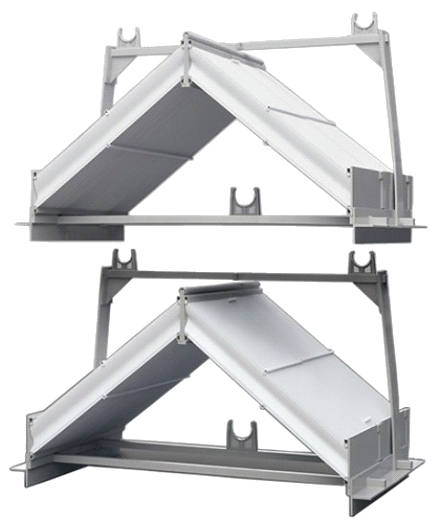
V Shape Mist Eliminators:
V-shaped vane type separator system for vertical gas flows. The system is typically used in gas cleaning devices such
as flue gas desulphurization absorbers and wet scrubbers. They have been specifically designed to address the
increasing performance demands of high efficiency mist eliminators. The system comes with an integrated online
cleaning system used in processes that could cause plugging and scaling on the vane surface. The system is designed
for a single, 2 or 3-stages with several cleaning layers depending on the specified liquid rest content and the operating
conditions.
Washing systems are completely integrated to the V-Shape modules, thus no separate support structure for the
washing system is needed. For application with high cleaning requirements the V-Shape module is equipped with both
upstream and downstream cleaning devices. Eventus’ top tier partner supplies beside performance guarantees data
for cleaning cycles, water consumption, nozzle and pump data and peripheral data for integrating the system into the
absorbers/scrubber structure.
Target applications
- Flue gas desulphurization plants for processes with high turn down ratios.
- Exhaust air treatment plant.
- Waste Incineration plant.
- Inlet and exhaust scrubbers with high cleaning requirements
Materials of Construction
Mist elimination systems: – PPTV, PPHT, PP, FRP, PPGC, PSU, Stainless steel 316.
Flushing systems: – PP, FRP, Stainless steel 304 and 316.
Getting the best in mist elimination
In an ideal world, Munters’ mist elimination systems are designed as an integral part of the FGD system from the very
start. When this is not possible, they can be implemented wherever Flue Gas Desulphurization systems are in use.
Munters’ systems are designed for the real world, to accommodate towers of widely varying designs, with vertical or
horizontal flow, even where there are dimensional limitations or flow problems. What you get is a range of optional
configurations optimized by experts who know how to get the very best out of each system.
For more information please click here
GAS – LIQUID SEPERATION
In general words, we have a solution for your process for:
- Removal of liquid carry-over
- Removal of condensed liquid
- Removal of contaminants
Mist eliminators will help you to:
- Protect downstream processes and equipment from corrosion
- Save energy in subsequent process stages
- Recover valuable product
- Perform predictably and at high efficiency even under heavy liquid loading
- Using a vane type mist eliminator allows the process to be run at higher velocities, and thus with smaller apparatus diameters
Throughout many chemical processes, liquid-gas separation plays a vital role in recovering lost product or in protecting downstream equipment and processes from droplets in the gas stream. These droplets could be impurities in the gas phase, caused by condensation during cooling or they are simply caused by high gas velocities resulting in liquid carry-over.
In every case, efficient separation, designed specifically for the job in hand, will save money through recovery of product, enhanced process efficiency and/or reduced wear and damage to equipment. Solutions include customized liquid-gas separation equipment and demisters for horizontal and vertical flow in the following applications:
- Sulphur separation in Claus plants
- Separation of methanol from acid gas
- Synthesis gas droplet separators for Ammonia plants
- Condensate separators for nitric and phosphoric acid plants
- Cracked gas suction drums for Propylene / Ethylene production
- Natural gas and Syngas KO Drums
- Multiple stages KO Drums for liquid slugs at the well head including sand and solid particles using i.e.
filter cartridges and vane sections - Natural gas liquid extraction and glycol dehydration
Processes with Horizontal Flow
Selecting the right vane profile and the amount of stages for your demister for horizontal flow are key parameters for finding the right costs / benefit performance in your separation project. Together with certain peripherals such as integrated spray piping systems and nozzles for cleaning. Our partners can design and offer the internals or the complete package with casing, vessel, piping and fittings as necessary necessary.


The vane type droplet separator or mist eliminator is used for applications with horizontal gas flows. The vane is suited for low to high gas velocities, eliminates very fine droplets and can be configured to most individual performance demands using various pitches. The benefits includes energy saving operations due to the very low pres sure loss and higher separation efficiency. The applications are in gas cooling processes, removal of condensed liquids, gas cleaning device, absorbers, exhaust air treatment plants, chemical plants, etc.
Typically used for liquid separation prior to compressor stations or for protecting equipment downstream like catalytic reactors, flares and others. The final configuration and internal parts of a knock out drum will depend on the type of industry and application as well as the expected amount of liquid to be seperated.
This is an advanced type of inlet distributor that is commonly used for introducing gas/liquid mixtures into a vessel or a column. It removes liquid slugs and optimizes the downstream gas flow. The liquid removal capacity of the IDM is very high, with an efficiency of around 90 %. It is designed to handle very large liquid fractions and slugs, yet it has a low pressure drop and a very high resistance to fouling. The IDM not only removes the bulk of the liquid, it also evenly distributes the onward gas flow. The applications include Methanol plants, Olefin plants, Ammonia plants, Compressor suction drums and Knock-out drums.


Processes with Vertical Flow
Demisters for columns, vertical vane separations as equipment internals, for pipe systems, ducts and stacks.
The most established and popular vane type separator for vertical flow and extremely low pressure drop for speed velocity range 1 to 5 m/sec. This separator is built by modular elements and can be installed via manhole; suitable for retrofit. This gas-liquid separator is available in round shape, rectangular shape as well as in tailor-made arrangement. It can be supplied together with housing and with integrated flushing / cleaning systems for sensitive applications.


Chevron type droplet separator is a vane type separator for vertical flow. The gas flow charged with liquid droplets is directed through separator chambers which are designed for maximum effect on the gas flow. As a result of this configuration, inertial forces act on the droplets. The droplets impinge onto the profiles, where they form a liquid film which is subsequently drained off as a result of gravity. V-shaped impressions on the separator plates ensure that the liquid is drained off in the correct manner and returns to the gas flow.
- Evaporators
- Absorbers
- Gas scrubbers
- Desulphurization units
- Gas coolers
- Exhaust air treatment plants
- Chemical plant
PE, PP, PPGC, PVDF and stainless steel alloys ASTM 304, ASTM 316Ti, ASTM 316L, ASTM 321; DIN 1.4301, DIN 1.4404, DIN 1.4541, DIN 1.4571.
Special materials are available upon request.